Too Gay to Be Bi 🩷💜💙
Yesterday, an old colleague confidently informed me that I am not bisexual!
Not because they had lived my life or known my relationships, or because they had any intimate knowledge of my attractions. But because they had “met me.” Apparently, that was enough for them to know my orientation!
What began as a conversation about a story I am currently writing slowly drifted towards sexuality, labels, identity, and eventually, me. Somewhere in the middle of that discussion, I mentioned that while “I am not particularly fond of labels, if I had to choose one, I identify as bisexual.”
And mind you, the person also associates themselves as part of the queer community. And funnily, their response to my declaration of being Bi was immediate, “No, you’re not.”
A more reasonable response could still have been — “Really?” or “I didn’t know that.” or “Tell me more.”
Rather it was just a flat-out rejection of a reality I have lived with for years.
And I found that fascinating… Maybe a little offensive too, but not too shocking. Just fascinating… because it reminded me of something that bisexual people often encounter, both inside and outside the LGBTQIA+ community: the assumption that other people know us better than we know ourselves.
The assumption usually doesn’t come from malice as much as it comes from stereotypes. From wanting to fit people into boxes!
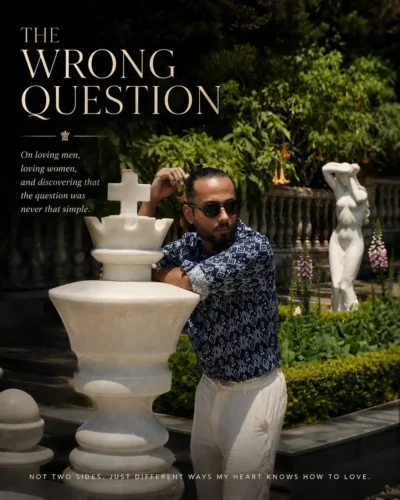
People claim they understand sexuality through attraction, but more often than not, they judge it through appearance, mannerisms, the way someone walks or talks or dresses. Their interests, hobbies and skills! And in doing so somewhere along the way, they start confusing gender expression with sexual orientation.
A feminine man must be gay. A masculine man must be straight. A woman who dresses a certain way must be a lesbian. A man who enjoys traditionally feminine forms of self-expression couldn’t possibly be attracted to women.
At least, that’s what many people seem to believe. Reality, however, has never been that simple! Gender expression and sexual orientation are not the same thing.
Gender expression is how we express ourselves to the world. While sexual orientation is about who we are attracted to. For some people, the two may align with society’s expectations. For many others, possibly like me, they don’t.
A man can be masculine and gay. A man can be feminine and straight. A woman can be masculine and heterosexual. And yes, a feminine man can be bisexual!
The fact that this still surprises people in 2026 says more about our assumptions than it does about reality.
What struck me most during the conversation wasn’t that someone assumed I was gay. That has happened many times before. I’ve myself seen me as gay for the longest time, up until I was 24 years of age. But that’s another journal entry.
What struck me was what happened after I corrected the assumption… The assumption still remained. The evidence changed… But the conclusion did not.
And perhaps that is the simplest definition of prejudice. Not hatred, or hostility, but just the refusal to update a belief when presented with new information.
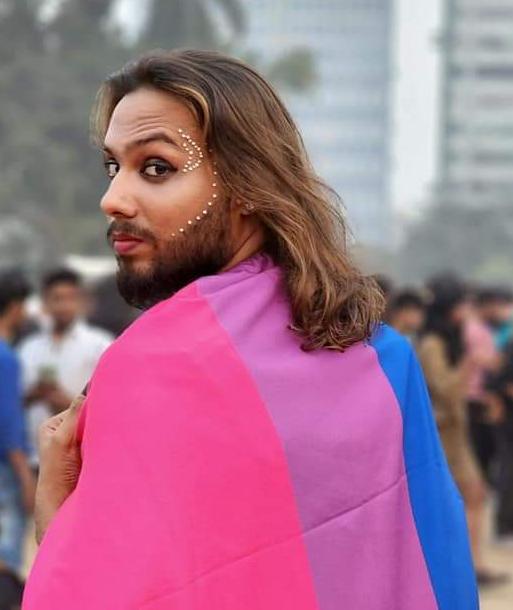
Bisexuality occupies a strange place in our collective imagination. If a bisexual man is dating a woman, he is assumed to be straight. If he is dating a man, he is assumed to be gay. If he is single, people often decide his orientation based on how he presents himself. In every scenario, the “bi” somehow disappears. This phenomenon even has a name: “bisexual erasure” or “Bi-erasure”
Bi-erasure is the tendency to dismiss, invalidate, ignore, or explain away bisexual identities because they do not fit neatly into the categories people are comfortable with.
Ironically, bisexual erasure is often experienced not only from heterosexual society but also from within queer spaces themselves.
We are too straight for some. Too gay for others. Never quite fitting into the boxes people have already prepared.
But perhaps the larger issue isn’t bisexuality at all. Perhaps the larger issue is certainty. We live in a world where people are increasingly comfortable making definitive conclusions about lives they have never lived. We see a few pieces of information and convince ourselves we know the whole story. A voice becomes an identity. A gesture becomes an orientation. A single meeting becomes a biography. And a stereotype becomes a fact.
The older I get, the less interested I am in convincing people otherwise. I don’t need everyone to understand my life. I don’t need everyone to agree with how I identify. And I certainly don’t need permission to exist as I am.
But I do remain curious about how quickly people trust their assumptions over another person’s lived experience. Perhaps the most ironic part of the entire conversation was that the person speaking to me was convinced they knew me because they had “seen me.” Yet they never once asked me about my experiences.
They looked, they concluded based on their limited experience and knowledge and they decided a label to slap on my forehead!
And somewhere in that process, curiosity died. Maybe that is what erasure really looks like.
It is not always hatred or discrimination or hostility. (that is phobia, and a conversation for another time.)
Just the quiet certainty that someone else’s story has already been written based on your view of the world, even before they’ve had the chance to tell it.
And maybe that is why so many bisexual people spend years feeling unseen. Not because they are invisible. But because people are often looking for confirmation of what they already believe, rather than the truth standing right in front of them. 💜
Bi & Proud ✨
Journal entry
19th June 2026
Dr. Krishnendu Chatterjee