✨ I Am a Man Who Cries ✨
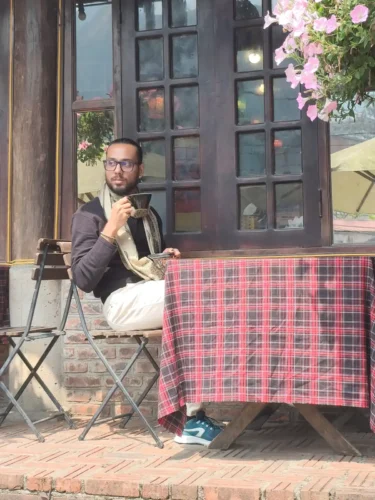
Not long ago, I was sitting in a café with my girlfriend when our conversation drifted towards my past. We spoke about old relationships, childhood memories, and experiences that I had long since moved on from. They were no longer open wounds, yet some part of me still carried traces of pain associated with those moments. As I spoke, I found myself touched by a quiet sadness—not the kind that overwhelms or debilitates, but the soft melancholy that remains after grief has already been processed and understood.
Sensing it, she held my hand and gently said, “You know you can cry if you feel like it.”
What surprised me was not her statement but my own response. Almost instinctively, I replied, “Of course not.”
“Why not?” she asked.
“I’m a man.”
The moment those words left my mouth, I could almost see years of calling myself a feminist and speaking against gender stereotypes crumble before my eyes. Here I was, someone who had spent years questioning social conditioning, unconsciously carrying one of its oldest messages: “Men don’t cry!”
That thought stayed with me. And this morning, while sitting by myself, I found myself wondering why we were taught this in the first place. Why is crying considered undesirable? Why do we associate tears with weakness? At its core, crying is simply an emotional response, no different from laughter, awe, affection, or joy. It is a physiological and psychological expression of what we feel. Yet somewhere along the way, many of us learned to regard it as something shameful.
The truth is, I have cried throughout my life, but mostly alone, behind closed doors. I have cried while watching films and reading stories that moved me deeply. I have felt tears well up while listening to songs—sometimes from heartbreak, sometimes from nostalgia. There have been moments in my spiritual journey when merely seeing my Master brought tears to my eyes out of longing, devotion, and gratitude. Strangely enough, I have cried very little in the face of death. The only loss that I distinctly remember bringing me to tears was that of an uncle who was very dear to me.
The ability to cry was never absent. What was present, however, was conditioning. Society has long taught men that tears are incompatible with strength. Men have often been expected to be providers, protectors, and pillars of stability. When others depend on you, any visible crack in that façade can create fear — not only within yourself but sometimes within those who lean on you for support. Perhaps that is why vulnerability became confused with weakness and emotional restraint became confused with strength.
But the older I grow, the less convinced I am that this equation makes sense.
Men experience physical pain because we possess the same nervous system as every other human being. We experience emotional pain because we possess the same capacity for attachment, loss, disappointment, love, grief, and longing. If we acknowledge the existence of that pain, why would we deny ourselves one of the natural mechanisms through which the mind and body attempt to process it?
What if we look at it through a different lens? Imagine finding something genuinely funny and being told, “Strong men don’t laugh.” Imagine suppressing every smile, every chuckle, every burst of joy because expressing it might make you appear weak. The idea sounds absurd. Yet many of us have spent years doing precisely that with sadness. We learned to hold back tears, to swallow grief, to remain composed at all costs.
The problem with repressed emotions is that they rarely disappear. More often, they accumulate. Unexpressed sadness eventually transforms into frustration. Grief becomes anger. Hurt becomes resentment. What was never allowed to flow through us finds other ways to manifest itself. Sometimes it emerges as anxiety, sometimes as emotional numbness, and sometimes as behaviours that harm both ourselves and others.
I am not advocating emotional impulsiveness or suggesting that every feeling must be expressed dramatically. Emotional responsibility remains important. So does strength and resilience. Yet perhaps crying is not the opposite of those qualities. Perhaps it is one of the tools that allows us to cultivate them. Sometimes a few tears help us process an experience, release what needs releasing, and continue forward with greater clarity than suppression ever could.
Today, I am not claiming that I cry at the drop of a hat. But I no longer believe there is anything shameful about crying when life genuinely moves me to tears. I would rather allow myself an honest moment of vulnerability than deny it for the sake of performing an idea of masculinity that no longer serves me.
I know my strength. I know my resilience. A few tears cannot diminish either of them. Neither can they emasculate me. If anything, they remind me that beneath every role I play and every expectation placed upon me, I am still human.
And so today, without apology or embarrassment, I can say this with complete comfort:
I am a man who cries.
12 June 2026
8:18 AM