Can We Really Un-love Someone?
On love, letting go, and why moving on doesn’t always require us to stop loving.
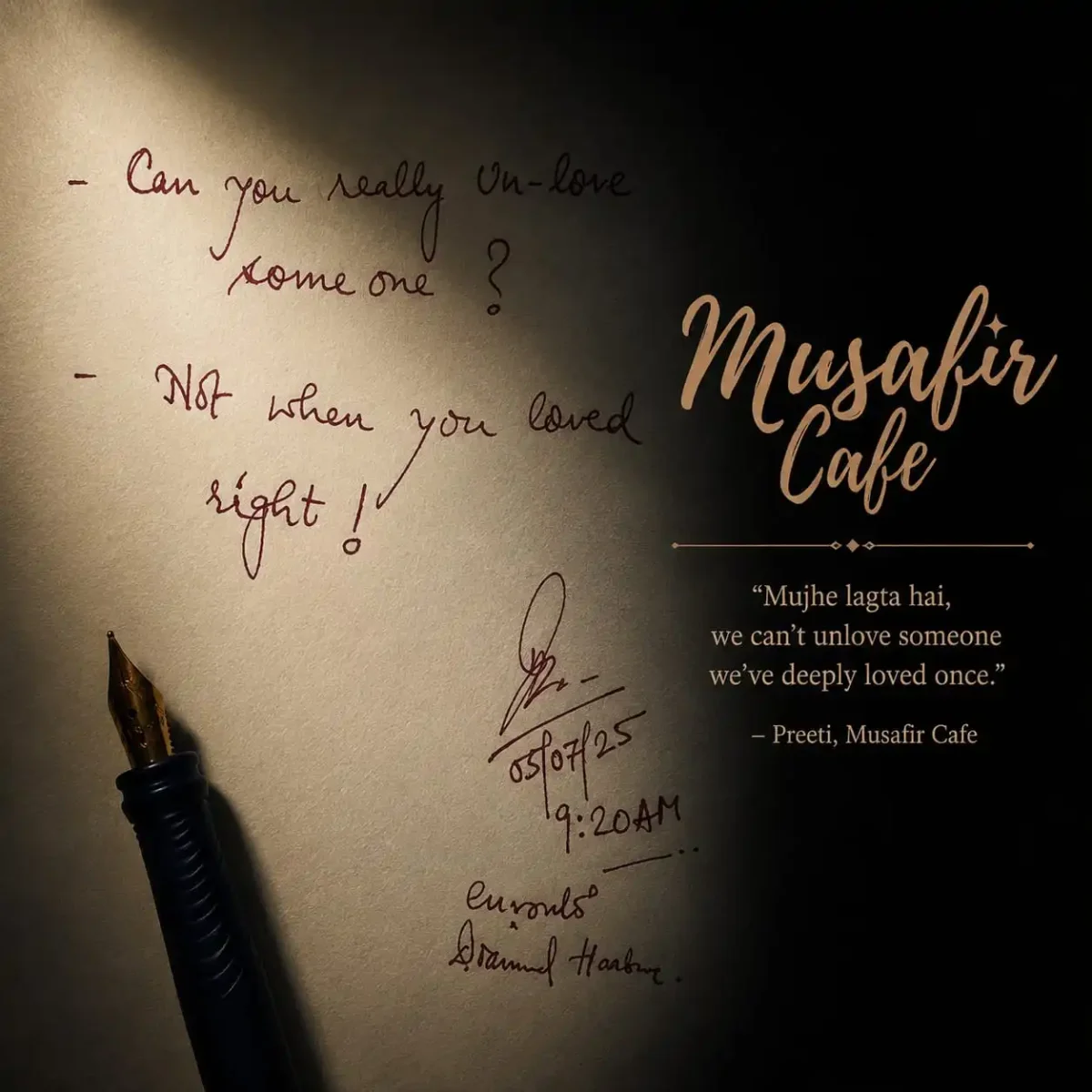
“Mujhe lagta hai, we can’t unlove someone we’ve deeply loved once.”
— Preeti, Musafir Cafe
As the scene played out on my TV screen, I paused to make a note… Not because the thought was particularly new to me. Rather, the opposite. I had written almost exactly the same thing more than a year ago.
On 5th July 2025, two lines had found their way into my notes:
“Can you really un-love someone?”
“Not when you loved right!”
At the time, it seemed almost self-evident to me. Apparently, it wasn’t. I was still handling remnants of lingering feelings for “N”.
Almost a year later when I shared those lines on my Instagram stories, a friend, Nisha replied almost immediately — “Waah… yes, I can totally unlove someone. Be practical.”
I replied — “Then you didn’t love right!”
And thus began a rather long conversation — or perhaps, a debate — about love.
She gave me an example I couldn’t dismiss quite so easily: what about someone who genuinely loves a person who later turns out to be abusive? Does the abuser’s behaviour somehow invalidate the love of the person who loved them?
At the time, I resisted that idea. “That’s not love to begin with,” I argued. Perhaps it was attachment or attraction or a trauma bond. Perhaps someone had fallen in love with a facade.
But she kept returning to one point — There are two people in a relationship.
One person’s inability to love well does not necessarily mean the other person’s love wasn’t real. I didn’t entirely agree with her then. Perhaps I still don’t.
As a hopeless romantic, “Love” still occupies a rather dreamy, utopian place in my mind.
But somewhere during that conversation, I wrote something that I believe much more strongly today:
“You can love someone and still choose to walk away, without unloving them or degrading that love.”
And then life happened. A few more weeks passed… relationships happened…breakups happened… therapy happened… healing happened…
And then, somewhere amid the recent social-media buzz around Musafir Cafe — and a particular song that had already made me cry even before I’d watched the series — Preeti appeared on my television screen and said — “We can’t unlove someone we’ve deeply loved once.”
And I thought — Ah. This again.
Except, perhaps, I wasn’t quite the same person answering the question anymore.
Earlier today, after finishing Musafir Cafe, I was discussing it with my friend Tanvi.
She was far less forgiving of its characters than I was.
To her, these were people repeatedly hurting themselves by remaining stuck in relationships and possibilities that had clearly run their course.
“Collectively I swear .. Chandar, Sudha and Preeti too… No mercy for anyone! Aur karo pyaar .. galat insaan se!”
I couldn’t disagree with that. In fact, at one point I told her —
“Yaar pyar galat sahi dekh ke nahi hota.. But haan us pyaar ka na muqammal hona jaan ke bhi usme fasey rehna — ye bewakoofi hai. That’s lack of self-worth.”
Which is interesting, because the younger version of me might have romanticised precisely that kind of longing. But the person I am today doesn’t.That is possibly the magic of therapy — learning to prioritise myself instead of abandoning parts of myself for love.
And yet, watching these terribly flawed people remain trapped in loops of their own creation didn’t make me angry. It made me strangely compassionate.
“Sometimes people don’t know better,” I told her.
Tanvi said – “Maybe I just rejected this energy of lacking self-worth, instead of rejecting the people.”
I replied – “And maybe their energy felt like an old me… That’s why the nostalgia!”
And as I typed in the messages, I realised why the series had affected me differently from her. – “Been there. Done that. Not anymore.” But I remember what it felt like…
I continued – “Again, not saying it’s the right thing… Just saying, Shit happens!”
Then Tanvi said something that changed the conversation completely. She had loved someone who wasn’t good for her. She had eventually stopped loving him. But the damage remained much longer.
In her words — “Uske pyaar se toh main one year mein hi nikal chuki thi, par the damage really took over.”
And suddenly something clicked. She had stopped loving someone and continued hurting. I had stopped hurting over people and, in some strange quiet way, continued loving them, in my own mellow way. We weren’t contradicting each other.
We were describing two entirely different experiences of love and healing.
So I told her – “You know what, Tanvi. That thing Preeti says to Rahil… about not being able to un-love someone… I’ve felt that… Deeply!
Mostly because I’ve always and only loved people who were good humans. Just that our love never had a story longer than what it was.”
She replied with one word — “Isliye!” (That’s why it makes sense).
And perhaps that really is why. I have been fortunate.The people I have deeply loved weren’t people I needed to erase from my heart in order to heal.
Some relationships simply didn’t work. Sometimes we just grew apart. Sometimes circumstances weren’t right. Sometimes we wanted different futures. Sometimes two perfectly decent human beings simply weren’t capable of writing a longer story together. That doesn’t make the chapters we did write any less beautiful.
Maybe that’s also why I can remain friends with some of the people I once loved. I don’t need to hate them to know I shouldn’t be with them. I don’t need to make them smaller to make my decision to leave bigger. And I don’t need to rewrite a beautiful past merely because it didn’t become my future.
But this also means I would change something about those two lines I wrote last year.
Back then I wrote:
“Can you really un-love someone?”
“Not when you loved right!”
Today, I’m not sure I would say “not when you loved right.”
Because that inadvertently suggests that someone who eventually stopped loving had somehow loved incorrectly. And I don’t believe that anymore.
Sometimes people need to stop loving. Sometimes love fades naturally. Sometimes betrayal changes what we feel. Sometimes the person we loved becomes someone we no longer recognise.
Sometimes healing may mean preserving the “Love”. Other times, healing may mean letting even the love go. Who am I to decide which one is more authentic?
Perhaps the mistake is believing that moving on has anything to do with how much love remains.
Because love, attachment, longing and choice aren’t the same thing.
You can love someone and not want them anymore.
You can miss someone and know you shouldn’t call them.
You can cherish what happened and never want it repeated.
You can forgive someone and never allow them back into your life.
And you can love someone deeply while choosing, with complete clarity —
Not you. Not anymore.
Maybe that’s what I understand today that I didn’t quite understand in July 2025.
Moving on doesn’t necessarily mean un-loving.
It means the love no longer gets to make your decisions for you.
It no longer determines whether you sleep peacefully at night.
It no longer keeps you waiting beside doors that aren’t going to open.
It no longer asks you to abandon yourself in order to preserve it.
The love may remain.
Or it may not.
Either way, you move.
So, Preeti… when you say, “Mujhe lagta hai, we can’t unlove someone we’ve deeply loved once.” I understand what you mean. I have felt it too… Deeply!
But perhaps, today, I would answer you differently.
Maybe we can un-love someone. But maybe we don’t have to.
What we absolutely must learn is when to stop choosing them.
Because perhaps the opposite of moving on was never loving…
It was staying stuck!
Journal Entry
Dr. Krish
12th August 2026