My Tricky Relationship With My Mother
on loving our parents, surviving them, understanding them — and eventually finding them inside ourselves
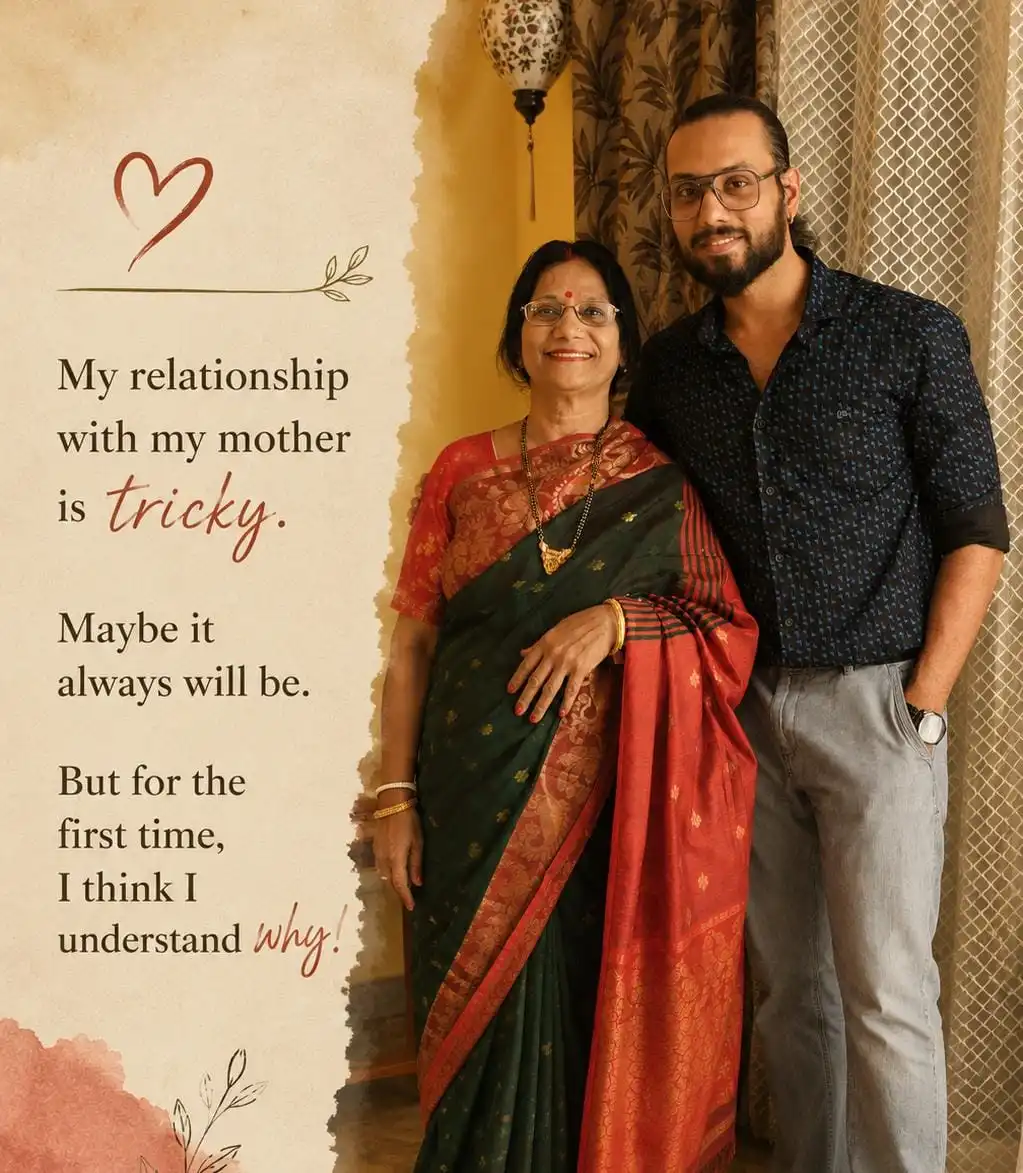
This morning, after a week-long visit to my place, I saw Mom off on her train back home to Asansol. Yesterday had been her birthday — a quaint, extremely personal celebration that began with puja at Dakshineshwar, followed by a little shopping, a small cake-cutting at home, and dinner with some of her favourite dishes.
My friends had been wanting to meet her; some did, while some couldn’t make it owing to their schedules. Some newer friends and acquaintances asked me this week how it felt having Mom stay with me — and today, how I feel now that she’s returning home. And I’ve often said this — “I’ve a tricky relationship with my mother!”
I love her. She loves me to the core. I know that.
I also know that I cannot imagine living with her under the same roof for more than a few days without eventually wanting to pull my hair out.
Both are true.
My older friends know it well. For years, I thought the difficult parts of our relationship came from everything that was different between us. Our worldviews. Her conventionality against my need to question things. Her anxieties against my need for freedom. Her ideas of what a successful life should look like against the life I have chosen to build.
Therapy, however, did something rather inconvenient.
It made me realise how much we are alike! And perhaps understanding my mother began when I started recognising parts of her inside myself.
The Mother I Was Angry With
On 27th March 2025, as an extension of a therapy homework, I wrote a poem about her.
Let’s say, it wasn’t particularly gentle. I was trying to process years of anger, frustration and questions I had never satisfactorily answered.
What hurt you so bad that you can’t question the norm
And why is it important which caste my friend is from
Misogyny n Patriarchy n Divisive comment
That surge outta you to make others lament
Negotiating between crushed dreams & shattered hope
You define success from validation like dope
Why do you think you’re a failure if you are not the herd?
And why does it take for you to lie, to be heard!
The manipulation, conspiracy, dishonesty & deceit
What do you fear losing if you have to face defeat
From a conflict that makes you bite the ones you love
And make their every day life so tough
You gaslight yourself when things don’t go your way
Your cruel hurtful words are price your loved ones have to pay
What do you fear losing if you’re not right
And what keeps you up when you lose a fight
They are people you love against who you wage a war
And want them to stay close while pushing them afar
Why are you blinded to reason and logic
Averse to talking about things not frolic
Your self righteousness leaves us empty and dry
And emotionally unavailable leaving you lonely to cry
What do you think? Is it sacrificial unconditional love?
No! It’s mere over bearing anxious parenting stuff
You dunno what to say to whom n where n why
Your embarrassing words make our brains fry
You shut a blind eye to things you think don’t matter
Even if the feelings of your child is left to shatter
“Are you jealous? Are you crazy? Are you selfish?” — he cries
And all you say is — “I love you despite all of my lies!”
Looking at it now, I don’t want to correct that poem. That anger was real. It was a verbalisation of years of frustration that I was beginning to work through in therapy. Today, I treat that poem as an archaeological record of where I was emotionally at that moment.
What has changed since then isn’t necessarily my memory of what happened. What changed was the question I started asking.
Instead of only asking, “Why are you like this?”
I began asking, “What happened to you that taught you to be like this?”
Before She Was My Mother, She Was Someone’s Daughter
I grew up hearing stories of my mother’s childhood. Stories that reflected her unmet needs growing up in a household with a single income, limited resources and multiple siblings.
She was a girl in a family where being a girl determined what was considered worth investing in, as was common in many families of that time.
Her younger brother, despite being less academically meritorious than her, received resources to pursue further education. She wasn’t afforded the same opportunity because, eventually, she would be “married off.”
Why invest so much in a daughter who was going to belong to another household anyway?
Then she entered that household and didn’t exactly find the emotional security she had perhaps been denied before. She had a difficult relationship with her in-laws. She and my father were never really on the same page mentally or emotionally either. I don’t remember growing up watching a great romance. I remember a marriage… a settlement…
A partnership held together by responsibility, social expectations and perhaps that eternal Indian glue — “Log kya kahenge?”
And somewhere along the way, they made me the purpose.
Dad became the provider. Mom became the caregiver. And I became the purpose.
My father went after money so his son could have the best education he could provide.
My mother went after everything else. Waking me up, feeding me, dressing me, tying my shoelaces, sending me to school, waiting for me to return, taking care of whatever needed taking care of next.
They put me before themselves.
But somewhere in that enormous sacrifice lay something I would understand only much later:
A child being someone’s purpose sounds beautiful until the child realises what an enormous responsibility it can become.
Because if my happiness validates your sacrifices, eventually my happiness has to resemble the happiness you imagined for me.
The Provider and the Woman Who Couldn’t Ask
On 5th August 2026, at 1:04 pm, I made a small journal note from a Eureka moment while trying to explain my parents’ relationship to my father, over a call where he was distressed by yet another conflict they had had that morning.
Therapy had slowly helped me see a pattern, which I was exploring as I explained it to Dad over that call.
My father had built his identity around being the provider.
My mother, meanwhile, had needs she had either never learnt to express, had been penalised for expressing, or had learnt were somehow wrong to have at all.
So she doesn’t always say: “I need this.”
She feels deprived. Perhaps because she never learnt how to communicate those needs safely, she holds them in. The frustration and resentment grow, as does the burden of having no one to help her meet those needs — sometimes even with simple things like daily chores. Eventually, when the unmet need becomes unbearable, it comes out as anger, accusation or conflict.
My father hears the dissatisfaction, and the provider inside him hears something else entirely:
“You failed to provide.”
Now his identity feels threatened. So he lashes out too.
And there they are. Two people in their sixties, sometimes behaving like two bickering teenagers who need someone else to tell them how to take care of themselves and their health.
And their thirty-something son sitting there thinking: “Oh. So THAT’S what has been happening all these years.”
Understanding it doesn’t magically make being around it easy. It merely makes it comprehensible.
Later the next day, I shared this with my therapist and we were both proud of my observation. But at the same time, he warned me to exercise caution so that I don’t land up becoming the bridge between my parents.
Understanding their relationship does not make me responsible for fixing it. My responsibility is to take care of my mental wellbeing and be there for them in the capacity of a son, not a therapist.
Unfortunately, I Am My Mother’s Son
I spent years identifying everything about my mother that triggered me… traits about her that I used to despise, even hate… mostly because I saw both my father and me suffer because of those traits. I have seen those traits become reasons for conflict and raised voices in my house.
But the most irritating discovery therapy gave me was that some of these traits quite comfortably live inside me too.
I learnt conflict from her. More accurately, perhaps, I learnt conflict escalation from her.
When I am hurt, my instinct can still be to lash out. When someone hurts me, some primitive little part of me wants them to understand my hurt by hurting too. I have simply learnt to tame it.
Therapy has given me enough space between feeling something and acting upon it that I can usually keep conflict civil.
Although there is an irony there too. Sometimes keeping it civil means the anger has nowhere immediate to go, and processing it internally becomes harder. Years of meditation have also softened some of its impact on me.
But I would still choose that over the conflict I grew up around. Because in our household, voices could rise, words could become weapons, and what I would now consider a significant argument could somehow fall within the normal range of family communication.
I don’t want that “normal” anymore.
Another thing I have inherited from both my parents is sacrifice as a language of love.
I give… more than I comfortably would if I love someone…
I accommodate… more than I would allow myself to, if I commit to a relationship…
I sometimes put someone I love ahead of myself.
It sounds noble until you realise that sacrifice without boundaries can quietly accumulate into resentment.
That, too, is something I have had to learn in therapy: where to draw the boundaries, and where to check myself from over-accommodating.
And then, bizarrely, my two kittens taught me something interesting too…
Apparently, Motherhood Is Hereditary!
Fathering Pride and Glitter, my two kittens, has made me confront my own parenting instincts.
Perhaps not as pronounced as my mother’s, but yes — there’s the worrying, the hovering, the separation anxiety, the need to constantly keep them in eyesight…
The — Have you eaten? Why haven’t you eaten? Where are you? What are you doing? Don’t go there… Don’t do that!
Sometimes the guilt-trips I throw at them! Or even the emotional dependence I’ve developed on their affection.
And then, sometimes I catch myself and think: “Oh God. I sound like my mother!”
It also made me understand something else. Love does not automatically make every expression of love healthy. You can adore someone and still suffocate them. You can desperately want to protect someone and accidentally prevent them from learning. You can do everything for someone because you love them and inadvertently communicate: I don’t trust you to manage without me.
Perhaps raising two kittens has taught me, in miniature, what I wish had sometimes been different in my own childhood.
Care for them, protect them, be available, but also let them become creatures independent of you.
Love shouldn’t require dependence in order to remain necessary.
I Inherited Her Devotion & Cleanliness Too
Then there are the similarities that make me laugh.
For all the differences between my mother’s religiosity and mine, I am finicky about my pujas too. And despite everything, I have somehow accumulated my own little “colony of Gods” on my puja altar, not unlike hers.
I suspect this is how ageing works. You spend half your youth announcing everything you’re never going to become, and then one afternoon you look around your house and realise your mother has somehow infiltrated the premises.
Even our cleanliness obsessions are related but incompatible.
She washes everything. I wipe everything.
Which means this last week when she was staying with me, inevitably the toilet seat was wet. The toilet floor never dried. Water had been splashed in places where, according to the constitutional laws of my household, SHOULD NOT HAVE BEEN SPLASHED!
She would also clean half the house, complete chores I hadn’t got around to, reorganise something useful and probably feed me somewhere in between.
But… not one bottle cap would be twisted shut properly. There would be salt and turmeric fingerprints on the kitchen cabinet handles. The fridge would look like an overstocked warehouse of food…
And then there was the kitchen floor.
AND WHY IS THE FLOOR STICKY?
God alone knows how, I would randomly find the tiled kitchen floor sticky — this time because she had spilled rosogolla syrup and hadn’t cleaned it in time!
I did mildly lose my temper about a few things and spoke rather rudely a couple of times. Maybe because she was casual about her meds, or she was overbearing about some topic of discussion. And then I realised something simultaneously encouraging and depressing: by the historical baseline of conflict in our family, this barely qualified as an argument.
Earlier, perhaps, I would have exploded. Now I have therapy. So instead I internally repeat: Just a few more days. Just a few more days and she will go home.
Growth comes in many forms. 😂
Why I Didn’t Go Home
Perhaps this is also why one of the most important decisions of my adult life was deciding that I would not return home permanently.
I first left Asansol at sixteen, in 2006, for my +2 education in Vizag. I returned for a year in 2008 after not cracking the medical entrance examination.
That year remains associated with a particular feeling: failure…
I remember feeling as though I had disappointed my parents. As though the resources they had spent on me needed justification. As though achievement somehow determined whether I had adequately earned everything being invested in me.
Then came five years of BDS in Kolkata and three years of MDS in Belagavi. By the time my postgraduate training ended in 2018, I was 28 and I had lived too much life outside that house to fit comfortably back inside it.
I could have returned to Asansol. Perhaps opened a dental clinic. Become a big doctor in a smaller town. It might even have been convenient. Like they said — “Ghor-er kheye thaaktis, onek taaka baachto” (You would have saved a lot of money, staying with parents and having home-cooked meals.)
But convenience would have cost me something enormous. Professionally, I wanted to build myself as an orthodontist. I wanted a bigger arena, specialised work, recognition and possibilities that being absorbed into general dental practice back home might not have given me.
But there was another reason too. The version of small-town life that awaited me there would have suffocated my queer, vibrant soul. I needed freedom. I needed spaces where differences didn’t constantly require explanation. I needed a life that wasn’t perpetually being measured against marriage, children, conventionality and heteronormative respectability.
I always knew one thing with remarkable certainty: I was not going back home to start my adult life with my parents.
It wasn’t because I didn’t love them. I moved away because remaining inside their ecosystem would have required me to become smaller so that I could fit inside it.
Perhaps distance became one of the ways I learnt to preserve my relationship with my mother. The same distance is sometimes pointed out as my reason for being a less responsible son.
Perhaps that’s another contradiction I’ve had to learn to live with: the distance that helped me become myself can also be used as evidence that I have moved too far away.
The Successful Unsettled Son
There is another irony that has been a constant bystander since I completed my MDS and started working. My parents are enormously proud of many things I have become. My work, my career, my independence, the money I earn, the recognition that occasionally comes my way.
And yet, in another column of the great Indian parental report card, I remain “a backlog.”
Unmarried… Unsettled…
Apparently everything else one builds in adulthood remains slightly provisional until somebody garlands you at a wedding.
My mother was diagnosed with diabetes this year, after being diagnosed pre-diabetic last year and remaining in complete denial of her blood sugar levels. Would you like to know one of the reasons she believes contributed to it?
Worrying about my marriage. 😂
I laugh. But it hurts.
Because somewhere underneath the comedy is an old exhaustion: “How much do I have to accomplish before my life is allowed to be considered enough?”
There is apparently no final examination I can pass. Because the syllabus wasn’t written by me!
Maybe “Tricky” Is the Right Word After All…
I used to think understanding my mother would mean deciding what she was —
Good mother? Difficult mother? Sacrificing mother? Manipulative mother? Anxious mother? Loving mother? Overbearing mother?
Therapy has increasingly made those categories feel inadequate.
She is the daughter who wasn’t given what she needed. The wife who didn’t necessarily find emotional companionship in marriage. The mother who poured an extraordinary amount of herself into her child. And sometimes expected that child to become proof that all of it had been worthwhile.
She loves me deeply. She has also at times hurt me deeply, in the past. Those statements do not cancel each other out. Understanding where her wounds came from doesn’t mean volunteering to keep being wounded by them. And setting boundaries with her doesn’t mean I have stopped seeing the love underneath everything.
Perhaps the strangest part is knowing that I carry some of her forward. Her temper lives somewhere inside mine. Her tendency to sacrifice, her anxiety disguised as care, her parenting instincts, her Gods, her obsession with cleanliness are all there inside me. Although mine is obviously the objectively superior version because I WIPE THINGS PROPERLY!!!
And maybe, as I grow older, I will discover even more of her inside myself. That thought once might have terrified me. Today, I think I understand it differently.
Inheritance isn’t destiny. I don’t get to choose everything my parents gave me. But perhaps I get to decide what I do with what I inherited.
I can keep the devotion and question the dogma. I can keep the generosity and put boundaries around the sacrifice. I can keep the fierce love and unlearn the need to hurt others when wounded. And I can keep the instinct to care while learning that care does not mean control.
And maybe that’s what therapy changed most.
The angry son who wrote that poem in March 2025 wanted to know: “Why are you like this?”
Today, I find myself asking something gentler: “What happened to you that taught you to love like this?”
Neither question erases the other. I still get irritated. I still sometimes speak rudely. She still gets magnificently on my nerves. And after a few days under the same roof, I will probably still count down to her departure.
But perhaps growing up wasn’t about finally deciding whether my mother loved me or hurt me. It was learning that she could have done both.
And that I can love her, understand her, be angry with her, set boundaries with her, laugh at her, occasionally become her… and still choose to live my own life.
So yes. My relationship with my mother is tricky.
Maybe it always will be.
But for the first time, I think I understand why!
Journal entry
Dr. Krish
17th August 2026