Why Does Being Bisexual Need So Much Explaining?
(notes from an otherwise fairly ordinary bisexual man during Bi-Visibility Month)
Most mornings, I don’t wake up thinking about being bisexual.
I wake up thinking about whether I have enough time for coffee, about my work for the day, my patients, maybe some unfinished blog post, about whether I should go to the gym today or successfully negotiate with myself for another rest day, what to make for lunch…
Sometimes about deadlines, family, friends, bills, groceries, messages I forgot to reply to and, every now and then, someone I am falling in love with.
Oh but most importantly feeding my two kittens and cleaning the litter bins!
I’m an orthodontist and in my leisure, I teach yoga, I write poetry, I sing…
I can be opinionated, stubborn, affectionate, ambitious, annoyingly particular about certain things and spectacularly absent-minded about others.
I’m a cisgender man. And somewhere amongst all these fairly ordinary facts about me… I am bisexual.
Well if you ask me if it really matters?
Of course it does… But it isn’t everything.
And yet, remarkably often, my bisexuality seems to occupy a perfectly ordinary amount of space inside me… and a considerably larger amount of space in everybody else’s imagination, while in mundane conversations.
The moment people discover that part of me, a strange questionnaire sometimes appears…
-
- “So… Do you like men more or women?”
-
- “Are you sure you’re bisexual?”
-
- “But you seem gay.”
-
- “Wouldn’t you eventually have to choose?”
-
- “If you’re with a man, won’t you miss women?”
-
- “If you’re with a woman, won’t you miss men?”
-
- “Can bisexual people really be monogamous?”
And one of my personal favourites — “Why do you need to tell anyone at all?”
Suddenly, this one part of my identity becomes a viva examination… And apparently I am both the candidate and the syllabus.
And just as much as I encourage people to be inquisitive about bisexuality, because to me, that also encompasses awareness, I do unfortunately abhor the prejudice and judgement that often accompanies some of these questions!
Apparently, I don’t look bisexual enough
One of the stranger things about bisexuality is discovering how many people believe they possess an “internal bisexuality-detection device.”
People look at your clothes, your mannerisms, your voice, your friendships, your personality, your dating history and make a diagnosis.
“Oh please. You’re gay.”
Or very occasionally for me, from the other direction—
“You’ve dated women. So you ‘can be’ straight.”
I find this fascinating. It is as if there appears to be some imaginary acceptable midpoint of masculinity, femininity, behaviour and sexual history where bisexuality apparently resides.
Move too far in one direction and you’re secretly gay.
Move too far in the other direction and you can be straight-passing.
I wrote about this earlier in Too Gay to Be Bi, because bi-erasure often doesn’t look like outright hostility.
(Click here to read the article)
Sometimes it looks almost playful. It comes disguised as jokes and laughter. And then there is a gentle raised eyebrow.
A friend saying, “Come on, you’re not really bi.”
But underneath that little sentence sits something much larger: I know your sexuality better than you do.
And that is an extraordinary thing to say to another adult.
Because…
A bisexual man dating a man does not become gay.
A bisexual man dating a woman does not become straight.
A masculine bisexual man isn’t heterosexual by default.
An effeminate bisexual man isn’t secretly homosexual.
Presentation isn’t orientation.
Neither is your current relationship.
I don’t have to “perform” bisexuality convincingly enough to retain it.
Apparently, my heart also requires a scoreboard
Next comes my other favourite question.
“So… who do you prefer? Men or women?”
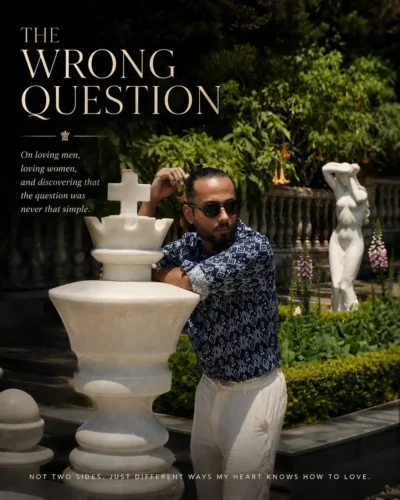
I’ve been asked versions of this so many times that I eventually wrote an entire article called The Wrong Question.
Because for me, it genuinely is the wrong question.
People seem oddly uncomfortable with the possibility that attraction may not fit neatly into a pie chart.
They want percentages.
60% men?
40% women?
70–30?
Maybe 80–20?
It’s almost as though somewhere there exists a Bisexuality Regulatory Authority and I haven’t submitted my quarterly figures.
But attraction doesn’t work that way for me.
I’ve realised over the years that my attraction towards men and women often follows different routes.
With men, physical attraction may appear first.
Chemistry… Curiosity… Desire…
With women, attraction has more often grown through familiarity, friendship, emotional intimacy, intellectual connection and feeling safe.
Different doors, but same house.
And then something even stranger happens once love actually enters the picture. The gender of the beloved becomes far less important than everyone assumes.
Who would I picture next to me on a slow Sunday morning?
Who do I pull closer? Kiss on the forehead? Who do I make coffee for while they’re still half asleep?
Next I imagined myself crashing after a long and awful day.
I’m sitting in my car outside the hospital and I don’t particularly want advice… just someone to hear me out and reassure me. I call my partner…
Who picks up at the other end? A man or a woman?
For me, eventually, that distinction begins to disappear.
I want the person I love. Someone who says — “You did your best. Come home. I’m waiting for you and I love you!”
That was perhaps one of the most comforting things I discovered while writing The Wrong Question.
Maybe my bisexuality was never asking me to divide my love equally between genders. Maybe it was simply asking me to remain honest about the different ways my heart knows how to arrive there.
Not that my heart is divided. Just that it speaks more than one language.
And then love actually walks into the room
Questions about bisexuality become even more interesting when you’re actually dating somebody.
Because suddenly, another kind of insecurity begins to lurk around the corner.
If I’m with a man the question appears in the mind of my date — “What if one day you want a woman?”
Because… convenience, sexual needs, familial and societal expectations!
And if I’m with a woman it becomes — “What if one day you want a man?”
Because… desires, physical needs, moral lapse, infidelity!
I understand where the fear comes from. When you love somebody, the thought that there might be some fundamental thing you can never provide them can feel frightening.
But there is an assumption hiding inside that fear. That bisexuality means constantly longing for whatever gender one’s current partner isn’t.
That isn’t how commitment works!
A heterosexual man entering a relationship doesn’t suddenly lose the ability to notice other women. A gay man doesn’t stop recognising attractive men because he has a boyfriend. Neither does a bisexual person become incapable of attraction to other human beings.
Monogamy isn’t the disappearance of attraction. It is a choice about what you do with it. Which means perhaps the real question to ask your bisexual partner isn’t: “Could you theoretically be attracted to someone unlike me?”
Of course they could!
The better question is: “When you choose me, what does that choice mean to you?”
Because orientation tells us who your heart may love.
Character tells us how.
The heterosexual escape hatch
And then bisexuality encounters family.
This is where things become considerably less philosophical.
One of the strange realities of being bisexual is that society can sometimes offer you an apparent escape hatch.
If you can love both men and women, then why not simply choose the option everybody finds easier?
Date women… Marry one and have the conventional wedding… the socially comprehensible marriage.
Let your parents breathe easily. Let relatives stop asking questions. Let society return to its preferred script.
Problem solved!
Except there was never a problem to solve.
When I came out to my father as bisexual, a couple of months ago, he did not explode into rage, disgust or disappointment. In fact, initially, he took it rather well.
But within a few days, he made it clear that accepting me with a male life partner would be difficult for him.
My mother is still oblivious to what being queer is!
In that context, there are people around me, well-wishers, who genuinely believe there is an obvious practical solution.
If women are also within the spectrum of people I can love… Why not just choose one and eliminate the consideration of a male partner altogether?
And sometimes the suggestion becomes even more uncomfortable.
Someone very close to me once asked, “Tum ko agar koi ladki mili, will you still be looking for men?” (If you get a girl as a partner, will you still be looking for men?)
My answer was an obvious “No!”
And then she casually, jestfully whispered, “To usko bataane ki zaroorat kya hai?” (Why do you need to tell a woman you’re bisexual?)
That question stayed with me, because underneath it is an entire philosophy, a whole school of thought regarding how relationships can work…
Why make things complicated? Why reveal something that may reduce your matrimonial prospects? Why introduce discomfort when silence would make everybody’s life easier?
In other words — Why choose honesty when concealment is more convenient?
And perhaps this is one of the strangest forms of bi-erasure.
Nobody is technically asking me to stop being bisexual. They are simply asking me to choose the version of my bisexuality that inconveniences them the least. And that is a much more socially acceptable request.
You may be bisexual. Just don’t date a man.
You may be bisexual. Just don’t tell the woman.
You may be bisexual. Just don’t make your family confront what that actually means.
You may remain exactly who you are…
provided nobody has to see it.
And suddenly something often described as “straight-passing privilege” begins to look very different.
Because being straight-passing is only a privilege if invisibility feels like freedom.
Sometimes it feels much more like being offered acceptance in exchange for editing yourself.
Convenience over honesty
I don’t believe every partner is entitled to every intimate detail of another person’s life.
Privacy matters, yes!
Past relationships don’t need to become forensic investigations. Nobody owes anybody a sexual résumé.
But my bisexuality isn’t an embarrassing incident in my past. It is part of how I understand myself. It is not my past. It is my present and a part of my identity.
(Someday I’ll write more elaborately about why I consider it a part of my ‘identity’, because I know some people will ask me that!)
So if I were building a life with somebody, deliberately constructing a heterosexual version of myself because it would make me easier to marry would feel deeply dishonest.
Not necessarily dishonest because of something I might do. Dishonest because of something I would deliberately ask her not to know. And I don’t want someone to fall in love with an edited version of me.
I don’t want the success of my relationship to depend upon keeping one part of my identity conveniently outside the room.
Perhaps that makes life harder. Perhaps honesty does reduce options. Perhaps some people would walk away. Well, let’s just say, they are allowed to.
But I think I would rather make honesty inconvenient… than make love convenient through dishonesty.
And apparently bisexuality is also a character flaw
Then comes another set of stereotypes.
Bisexual people are promiscuous.
Bisexual people can’t decide.
They are more likely to cheat.
They always need both men and women!
I’ve heard variations of all of them.
And I explored this earlier in The Illusion of Choice, after a conversation reminded me how easily people confuse orientation with character.
But the distinction is remarkably simple.
A dishonest person lies.
A loyal person remains loyal.
A manipulative person manipulates.
And a compassionate person loves.
It’s simple!
None of those qualities arrive gift-wrapped with an orientation.
A bisexual person does not possess twice the probability of infidelity because they may experience attraction towards more than one gender.
Human fidelity is not an arithmetic equation.
If one heterosexual man cheats, nobody publishes a warning: “Be careful dating straight men. They are attracted to women.”
If one gay man lies to his boyfriend, homosexuality isn’t suddenly suspected of producing dishonesty.
We recognise individual failures as individual failures.
Yet bisexual people are often expected to answer for everyone else’s behaviour.
Someone once dated a bisexual person who cheated. Or maybe someone knew a bisexual person who lied. Maybe someone came across someone who couldn’t commit. And suddenly the next bisexual person entering the room is required to present evidence of good character.
So here is perhaps the simplest way I can put it.
Question my fidelity if I betray you.
Question my integrity if I lie to you.
Question my commitment if I refuse to commit.
But don’t question any of those things simply because I am bisexual.
My orientation tells you something about the range of people I may potentially experience attraction towards.
It tells you absolutely nothing about whether and how I honour a promise.
Visibility isn’t about making bisexuality my entire personality
Which brings me back to September.
Bi Visibility Month.
The word visibility itself can sometimes make people uncomfortable.
-
- “Why do we need to know?”
-
- “Why talk about sexuality so much?”
-
- “Why make everything about being bisexual?”
And strangely enough, I partly understand the irritation.
Because I don’t want everything to be about my bisexuality either.
Most of my life isn’t.
I want to talk about orthodontics, poetry, fitness, travel, coffee, friendships, family, love, books, bad decisions, good food, spirituality, yoga, meditation, ridiculous gym milestones… and the thousand small things that make up an ordinary human life.
But visibility doesn’t mean inserting sexuality into every conversation.
Sometimes visibility is simply refusing to erase it from the conversations where it belongs.
It is saying —
Yes, I’m dating a man. I remain bisexual.
Yes, I may someday be in a relationship with a woman, and I will still remain bisexual.
Yes, I might choose a person irrespective of their gender as my partner and STILL remain bisexual.
No, my mannerisms don’t invalidate it.
No, my current partner doesn’t redefine it.
No, my capacity to love more than one gender does not make my commitment less meaningful.
No, I will not conceal it merely because disclosure complicates somebody else’s preferred narrative for my life.
And no…
I don’t owe anyone a choice between halves of myself simply because ambiguity makes them uncomfortable.
I don’t want my bisexuality to matter less
For a long time, queer acceptance has often been framed around a particular defence: “It doesn’t matter.”
Sexuality shouldn’t matter. And I understand what that sentence is trying to accomplish. But I don’t think that’s quite what I want.
My bisexuality does matter.
It has shaped who I’ve loved, how I understand attraction and love… heartbreak and healing… compassion and romance!
It has shaped conversations with partners and what marriage or long term companionship can look like for me.
It has shaped difficult conversations with family.
It has shaped some of my fears and joys and possibly a lot of my writing.
It has also given me a strangely beautiful understanding that love can arrive through very different doors and still become equally real once it enters.
So no…
I don’t want my bisexuality to become meaningless.
I simply want it to be allowed to matter normally.
Not as evidence or scandal or diagnosis. Not as a warning or as an invitation for debate. And definitely not the most interesting thing about me.
Rather, just one honest part of a complicated… or as I call it, a nuanced, human being.
Because after writing about bi-erasure, after defending bisexual people against assumptions, after examining whether I prefer men or women and after answering question after question about what my bisexuality means…
I find myself arriving at a different question this September.
Perhaps the question is no longer: “How do I convince people that my bisexuality is real?”
Maybe the question is: “Why does my bisexuality require this much convincing in the first place?”
I don’t ask other people to prove their heterosexuality. I don’t interrogate gay men about whether they have “sufficiently” ruled out women. I don’t demand a percentage breakdown of anybody else’s attraction before accepting what they tell me about themselves.
So perhaps visibility begins somewhere surprisingly ordinary, which is by simply believing people when they tell us who they are.
It begins with curiosity before assumption, honesty before convenience and with allowing another person’s identity to belong to them before making it about our discomfort.
My bisexuality is neither everything about me…
nor nothing about me.
It is simply one honest part of me.
And perhaps visibility begins when that is finally enough.
Dr. Krish
Journal entry
8th September 2026